
Surprising but true: perpetual futures can make a 1% daily move feel like a 100% event when leverage is applied — and many retail traders underestimate how quickly margin math and funding rates change the economics of a trade. This article uses a concrete, US-focused case to explain how OKX’s futures and derivatives stack works, what it actually buys you as a trader, where it routinely breaks down, and simple heuristics you can use when deciding whether to log in and take a position.
We’ll walk through a scenario: a US-based crypto trader evaluates a BTC perpetual on OKX, thinking about leverage, funding, liquidity, and account safety. Along the way you’ll get a reusable decision framework, an explanation of platform mechanics, and clear warnings about the boundary conditions where futures stop helping and start hurting.
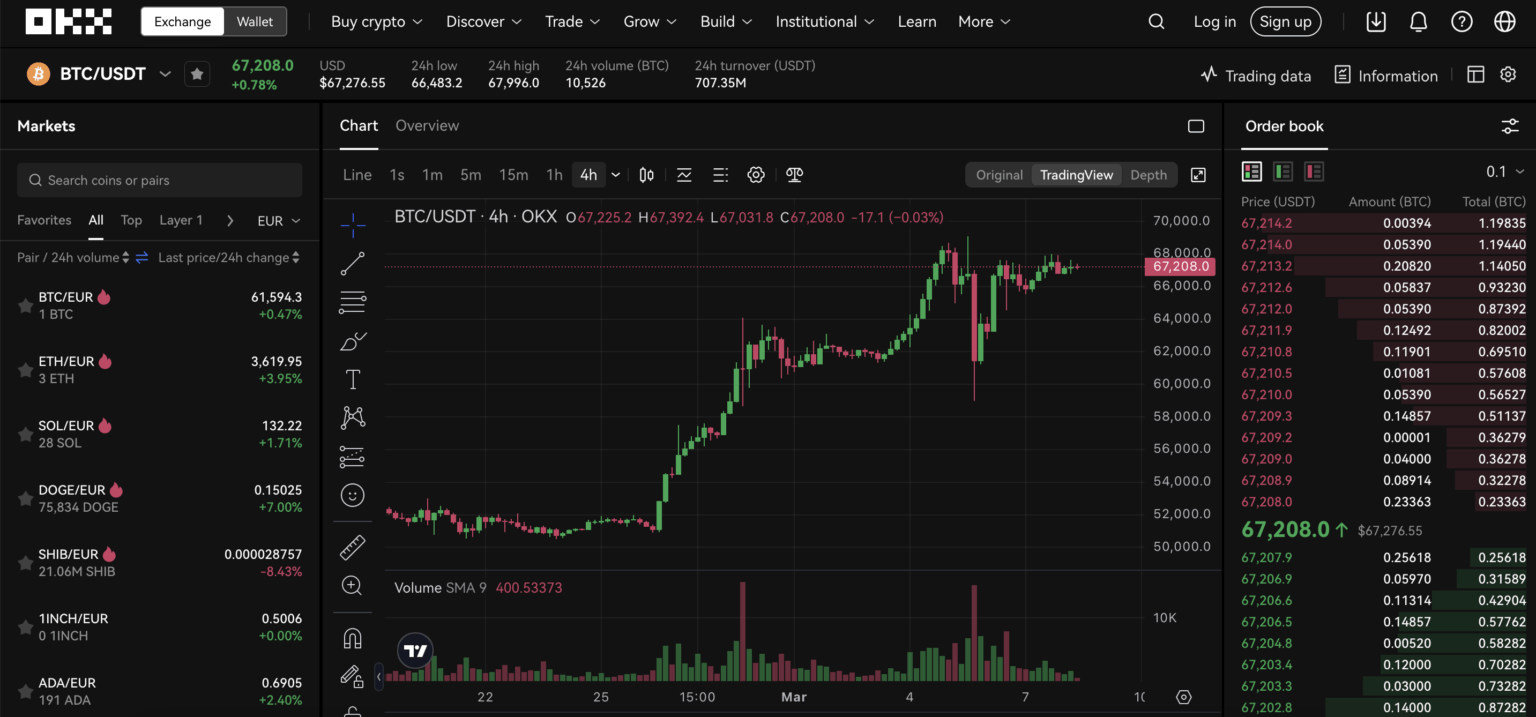
Case scenario: US trader evaluating a BTC perpetual on OKX
Imagine you’re logged into your OKX account, reviewing a BTC perpetual swap with 25x selected. The immediate appeal is obvious: small capital, amplified exposure. Mechanism-first: leverage multiplies both unrealized P&L and the liquidation trigger rate. On OKX you can use isolated margin (risk limited to that position) or cross margin (uses entire account balance). Each choice changes the liquidation mechanics and thus the size of positions you should accept.
Practical step: before placing the trade, check three things in this order — maintenance margin threshold, current funding rate, and orderbook depth. The maintenance margin dictates how close price can move against you before a forced close. Funding rates are periodic payments between long and short holders; persistent positive rates (longs pay shorts) erode returns for leveraged long positions. Orderbook depth indicates slippage risk at your target size. These are the concrete knobs that determine whether 25x is a tactical tool or a quick account-killer.
How OKX futures work, clearly and simply
Perpetual swaps on OKX behave like a continuous futures contract with no expiry; funding payments align contract price with the underlying index over time. Quarterly futures, by contrast, have expiry and settlement dates which can introduce roll risk as the expiry approaches. Options add asymmetric payoff shapes, useful for hedging but complex to price. OKX supports high leverage — up to 125x on some assets — but that upper bound is trading convenience, not advice. Higher leverage dramatically increases sensitivity to funding, slippage, and sudden liquidity gaps.
For US users, account controls and KYC matter: identity verification is required, and Two-Factor Authentication is mandatory. OKX combines centralized order matching with decentralized capabilities (a Web3 wallet, DEX aggregator, and staking/yield products). This hybrid model means you can shift from margin/futures trading to earning yield on idle assets or bridging to DeFi — but remember, moving assets outside the exchange changes the threat model from custodial risk to self-custody risks like seed phrase loss and smart contract exploits.
Common myths vs. reality
Myth: “Proof of Reserves means my position is risk-free.” Reality: PoR shows that OKX publicly attests to on-chain backing of deposits, which increases transparency but does not remove market, leverage, funding, or counterparty risks. It also doesn’t protect you from phishing or personal account compromise. Myth: “Higher leverage is just free return.” Reality: leverage magnifies directional exposure and implicitly shortens the time horizon for a position to go your way. A 10% drawdown that’s survivable at 2x is fatal at 20x.
Another misconception: “Futures liquidity is always deep.” OKX generally supports many liquid pairs, but the exchange routinely delists low-volume spot pairs as part of market hygiene. That same liquidity pruning can mean lower liquidity for niche derivatives, especially during market stress when bid-ask spreads widen and slippage grows. Always check the recent trading volume and open interest for the contract you intend to use.
Trade-offs and limitations: margin modes, funding, and cross-product risk
Isolated margin limits loss to the position but requires active management; cross margin lowers the risk of immediate liquidation by using your broader balance, but exposes your whole account to one bad trade. Funding rates reward or punish position holders over time — persistent positive funding can make a nominally profitable directional view lose money after funding payments are accounted for. Slippage and market impact are not theoretical: during rapid moves, virtual liquidity evaporates and liquidation cascades can spike realized losses.
Security trade-offs: OKX keeps over 95% of assets in air-gapped cold wallets with multi-signature withdrawal controls, which materially reduces exchange hack risk. Yet when you connect to DeFi from the platform — for yield farming or DEX routing — you inherit smart contract risk. If you withdraw to a non-custodial wallet, you take on seed phrase and self-custody risk; if you keep funds on the exchange, you accept custodial counterparty risk (partly mitigated by PoR and cold storage). Choose based on whether you value custody control or operational convenience more.
Decision framework: should you trade OKX futures right now?
Simple heuristic: answer three binary questions before entering a leveraged trade — 1) Do I have a time horizon shorter than the liquidation sensitivity implied by my leverage? 2) Is the funding rate regime favorable for my direction? 3) Is there predictable liquidity at my intended trade size? If you answer “no” to any, reduce leverage or wait. This frames leverage as a tool that compresses time, not as free alpha.
If you’re ready to act and just need the entry point to your account, use the platform’s secure login paths and follow mandatory 2FA and KYC steps carefully. A convenient link for getting started with the login flow is available here: okx sign in. Keep in mind OKX also offers biometric login through its mobile apps, but biometrics are a convenience layer — pair them with strong device security and 2FA.
What to watch next (signals, not promises)
Watch funding rates: persistent skew (longs paying shorts for multiple days) can flip the economics of carry trades. Monitor open interest and liquidation clusters: rising open interest with shrinking bid-ask spread is healthy; rising open interest plus widening spreads is a sign liquidity may not hold in a crash. Regulation is a live variable in the US — KYC and product availability can change as policy evolves; keep your documentation current and expect product regionalization to continue.
Also watch for routine platform housekeeping like delistings; OKX recently removed several low-volume spot pairs to maintain market quality. That’s normal, but it signals that niche tokens are more likely to suffer sudden liquidity and listing changes — an important boundary condition if you hedge derivatives with spot positions on the same asset.
FAQ
How does funding affect my perpetual position?
Funding is a periodic payment between long and short holders designed to keep the perpetual contract price close to the underlying index. If funding is positive, longs pay shorts; if negative, shorts pay longs. Over time, persistent funding can materially erode returns on leveraged positions, so always include expected funding cost in your position P&L model.
What’s the practical difference between isolated and cross margin?
Isolated margin confines risk to a single position: losses reduce only the allocated margin and then liquidate. Cross margin uses your entire eligible balance to prevent liquidation, which reduces the chance of an immediate forced close but exposes your full account balance to a single adverse move. Use isolated for discrete bets and cross when you’re managing correlated positions across instruments.
Is OKX safe to keep large balances for futures trading?
OKX employs industry measures — cold, multi-sig storage and Proof of Reserves — that reduce custodial risk. However, “safe” is relative: on-exchange funds are exposed to counterparty, operational, and regulatory risk. For large, long-term holdings not needed for active margin, consider segregating capital: keep trading collateral on the exchange and move long-term reserves to hardware-backed self-custody or institutional custody solutions.
How should a US trader think about KYC and account access?
KYC is mandatory and typically requires government ID plus facial liveness checks. This enables smoother fiat rails and withdrawal paths but ties your account to identity verification. Keep your KYC documents updated and secure; if you lose access or need support, having consistent KYC speeds resolution. Also enable 2FA and be vigilant about phishing attempts that target login credentials.
Takeaway: OKX futures are a powerful part of a trader’s toolkit when used with explicit margin math, funding-awareness, and liquidity checks. They compress time and magnify outcomes — good for tactical exposure, hazardous as a long-term substitution for fundamental conviction. Use the platform’s cross-product features thoughtfully, respect the limits of leverage, and prioritize both account security and a simple decision rule before you click submit.